
Are you tired of losing ranked games even when you have the most kills on your team? You might have god-tier aim and lightning-fast fingers, but your mechanics will only get you so far.
The harsh reality of competitive gaming is this: mechanical skill can win you a 1v1 duel, but superior decision making wins the entire match.
If you're stuck in a rank — Epic in Mobile Legends, Diamond in League of Legends, Crown in PUBG Mobile — your mechanics are probably fine. Your brain, though, is likely on "autopilot." In this guide, we'll teach you how to improve your in-game decision making, master macro play, and start climbing the ranks like a professional esports athlete.
What Is "Macro Play" in Esports?
In esports, gameplay splits into two distinct categories: micro and macro.
- Micro (mechanics): Your physical execution — aiming, dodging skill shots, executing complex combos, raw reaction time.
- Macro (decision making): Your strategic execution — map awareness, objective control, knowing when to fight, when to retreat, predicting enemy movement.
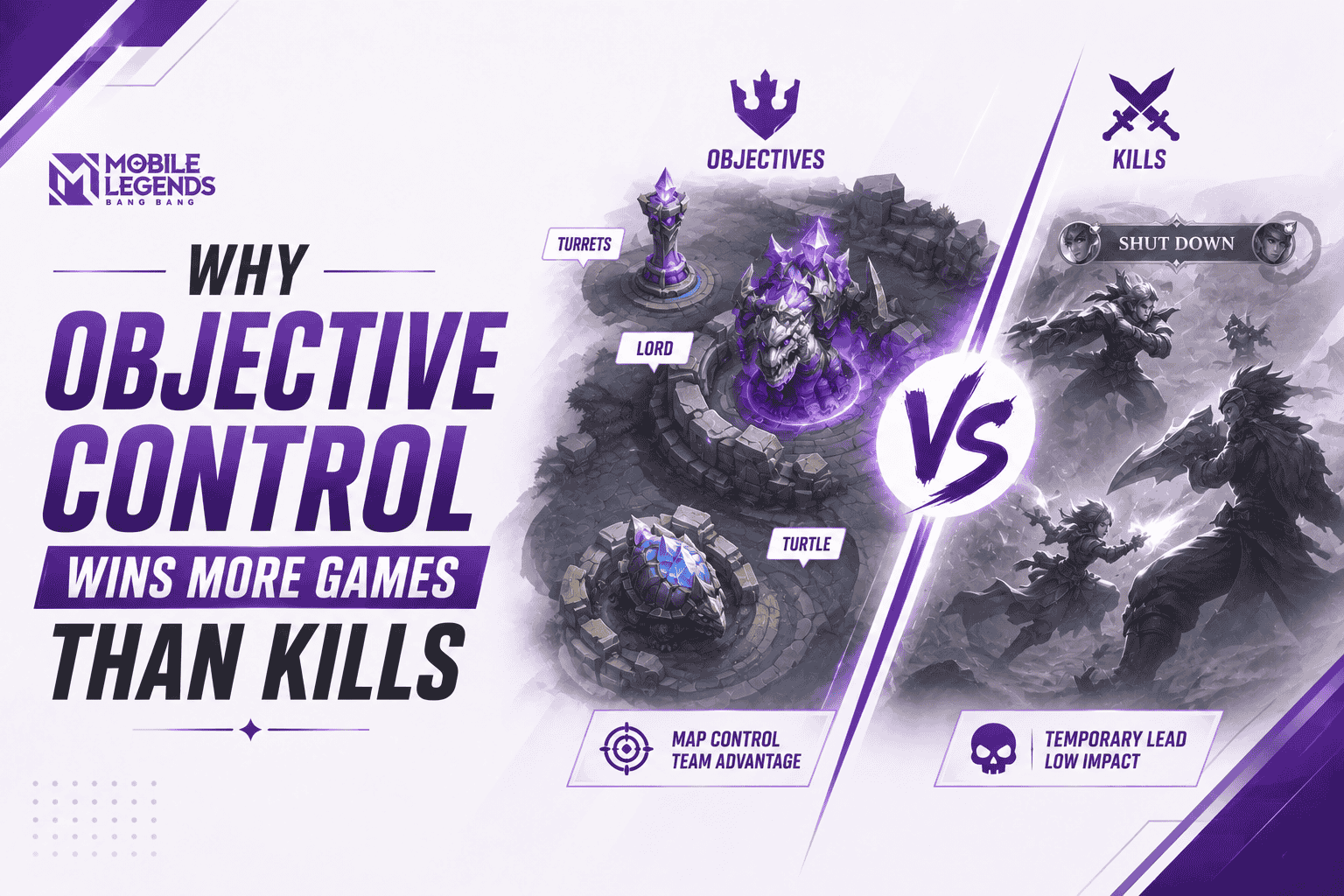
Why does macro beat micro in the long run? Because a player with incredible macro simply refuses to fight a player with incredible micro unless the odds are overwhelmingly in their favor. A smart player doesn't need to out-aim you if they can out-position you.
The Three Pillars of In-Game Decision Making
Improving your decision making requires a fundamental shift in how you process information mid-game. Here's the breakdown.
Information Gathering
Reading the minimap constantly, not just when returning to base.
Risk vs. Reward
Weighing what a play costs against what it actually earns you.
Execution Under Pressure
Committing instantly once you've decided — hesitation kills.
1. Information Gathering (Map Awareness)
You can't make a good decision without accurate data. The single most powerful tool on your screen isn't your weapon — it's your minimap.
Amateur players check the minimap only when moving from base. Professional players glance at it every 3 to 5 seconds, constantly gathering information:
- Where was the enemy jungler last seen?
- Did the enemy mid-laner just use their ultimate?
- Are my teammates positioned to follow up if I initiate a fight?
If you don't have answers to these questions, taking a fight isn't a strategy — it's a blind gamble.
2. Risk vs. Reward Assessment
Every action you take in a ranked game carries a risk and a potential reward. Good decision making is just the ability to calculate that math quickly.
Take chasing a low-health enemy deep into their jungle. The reward is one kill. The risk is their whole team waiting in the bushes to ambush you — resulting in your death, and handing them a major objective like the Lord or Baron.
The risk far outweighs the reward. Stop chasing kills if it means sacrificing map control.
3. Execution Under Pressure
Knowing the right move is step one. Having the confidence to execute it instantly is step two. Hesitation is a killer in esports. See an opening to take a major objective? Commit. Decide to retreat? Leave immediately. Lingering in the "gray area" of indecision will usually get you killed.
Practical Tips to Improve Your Decision Making Immediately
You can't just tell yourself to "be smarter." You need actionable steps to rewire your brain. Build these habits into your routine:
- Turn off autopilot: Never walk to a lane just because it's what you always do. Ask yourself out loud: "Why am I doing this right now? What's my goal for the next 60 seconds?"
- Play fewer games, review more: Instead of 10 ranked games in a row, play 5 and spend the rest watching your replays. Identify the exact moments you died and ask what information you were missing.
- Communicate your intent: Even in solo queue, ping aggressively. Tell your team what you're planning before you do it.
Summary: Micro vs. Macro Examples
To make this concept concrete, here's how a micro-focused player acts versus a macro-focused player in the exact same situation:
| Scenario | Micro-Focused Player | Macro-Focused Player |
|---|---|---|
| Enemy is low health near tower | Attempts a flashy dive for the kill, risking death | Lets them recall, denies their farm, takes tower plates safely |
| Major objective spawning soon | Farms a random jungle camp across the map | Recalls early, buys items, sets up vision around the pit |
| Outnumbered 1v3 | Tries to outplay all three with mechanical combos | Retreats immediately, wasting the enemy's time elsewhere |
The Mental Aspect: Tilt Ruins Decisions
We can't talk about decision making without talking about mental state. People are terrible at logic when they're emotional — in gaming, that frustration is called "tilt."
When you're tilted, your brain stops assessing risk vs. reward. You start taking forced, aggressive fights out of a need to prove you're better than the opponent. You stop checking the minimap. Your macro collapses entirely.
If you lose two ranked games in a row and feel your heart rate rising, stop playing. A 15-minute break to reset your mental state is the best macro decision you can make for your rank.
Conclusion: Key Takeaways
Improving your decision making is a marathon, not a sprint. It takes conscious effort to break bad habits and rewire how you process information.
- Macro beats micro: Brains eventually beat brawn in competitive gaming.
- Use the minimap: Information is power — glance at it every 3 to 5 seconds.
- Calculate risk: Never take a fight if the potential loss outweighs the potential gain.
- Watch your replays: Analyzing your own mistakes is the fastest path to improvement.
Stop blaming your teammates for every loss. Take accountability for your own decisions, focus on your macro game, and watch your win rate skyrocket. Good luck on the ranked ladder!
FAQ: Improving Decision Making in Ranked Games
What's the difference between micro and macro in esports?
Micro is your physical execution — aim, combos, reaction time. Macro is your strategic execution — map awareness, objective timing, and knowing when to fight or retreat. Macro tends to matter more as skill levels rise.
How often should I check the minimap in a ranked game?
Aim for every 3 to 5 seconds. Amateur players tend to only glance at it when returning to base, missing critical information about enemy rotations and cooldowns in the meantime.
What should I do if I feel tilted while playing ranked?
Stop playing. Tilt shuts down accurate risk-vs-reward assessment, so continuing usually leads to more losses. A short break, around 15 minutes, is often enough to reset and return with clearer decision making.